Filmare Nunta Fotografie Botez

Despre Filmare Fotografie Decoratiuni Aranjamente contact - Preturi Blog EmmE forum counter-strike,anunturi gratuite,director web,inscrie site,promoveaza-te

Saturday, December 20, 2008

Internet Protocol Suite

The Internet Protocol Suite (commonly TCP/IP) is the set of communications protocols used for the Internet and other similar networks. It is named from two of the most important protocols in it: the Transmission Control Protocol (TCP) and the Internet Protocol (IP), which were the first two networking protocols defined in this standard. Today's IP networking represents a synthesis of several developments that began to evolve in the 1960s and 1970s, namely the Internet and LANs (Local Area Networks), which emerged in the mid- to late-1980s, together with the invention of the World Wide Web by Tim Berners-Lee in 1989 (and which exploded with the availability of the first popular web browser: Mosaic).

The Internet Protocol Suite, like many protocol suites, may be viewed as a set of layers. Each layer solves a set of problems involving the transmission of data, and provides a well-defined service to the upper layer protocols based on using services from some lower layers. Upper layers are logically closer to the user and deal with more abstract data, relying on lower layer protocols to translate data into forms that can eventually be physically transmitted.

The TCP/IP model consists of four layers (RFC 1122).[1][2] From lowest to highest, these are the Link Layer, the Internet Layer, the Transport Layer, and the Application Layer.

History

The Internet Protocol Suite resulted from work done by Defense Advanced Research Projects Agency (DARPA) in the early 1970s. After building the pioneering ARPANET in 1969, DARPA started work on a number of other data transmission technologies. In 1972, Robert E. Kahn was hired at the DARPA Information Processing Technology Office, where he worked on both satellite packet networks and ground-based radio packet networks, and recognized the value of being able to communicate across them. In the spring of 1973, Vinton Cerf, the developer of the existing ARPANET Network Control Program (NCP) protocol, joined Kahn to work on open-architecture interconnection models with the goal of designing the next protocol generation for the ARPANET.

By the summer of 1973, Kahn and Cerf had worked out a fundamental reformulation, where the differences between network protocols were hidden by using a common internetwork protocol, and, instead of the network being responsible for reliability, as in the ARPANET, the hosts became responsible. Cerf credits Hubert Zimmerman and Louis Pouzin, designer of the CYCLADES network, with important influences on this design.

With the role of the network reduced to the bare minimum, it became possible to join almost any networks together, no matter what their characteristics were, thereby solving Kahn's initial problem. One popular saying has it that TCP/IP, the eventual product of Cerf and Kahn's work, will run over "two tin cans and a string." There is even an implementation designed to run using homing pigeons, IP over Avian Carriers, documented in RFC 1149. [3] [4].

A computer called a router (a name changed from gateway to avoid confusion with other types of gateways) is provided with an interface to each network, and forwards packets back and forth between them. Requirements for routers are defined in (Request for Comments 1812). [5]

The idea was worked out in more detailed form by Cerf's networking research group at Stanford in the 1973–74 period, resulting in the first TCP specification (Request for Comments 675) [6] (The early networking work at Xerox PARC, which produced the PARC Universal Packet protocol suite, much of which existed around the same period of time (i.e. contemporaneous), was also a significant technical influence; people moved between the two).

DARPA then contracted with BBN Technologies, Stanford University, and the University College London to develop operational versions of the protocol on different hardware platforms. Four versions were developed: TCP v1, TCP v2, a split into TCP v3 and IP v3 in the spring of 1978, and then stability with TCP/IP v4 — the standard protocol still in use on the Internet today.

In 1975, a two-network TCP/IP communications test was performed between Stanford and University College London (UCL). In November, 1977, a three-network TCP/IP test was conducted between the U.S., UK, and Norway. Between 1978 and 1983, several other TCP/IP prototypes were developed at multiple research centers. A full switchover to TCP/IP on the ARPANET took place January 1, 1983.[7]

In March 1982, the US Department of Defense made TCP/IP the standard for all military computer networking.[8] In 1985, the Internet Architecture Board held a three day workshop on TCP/IP for the computer industry, attended by 250 vendor representatives, helping popularize the protocol and leading to its increasing commercial use.

On November 9, 2005 Kahn and Cerf were presented with the Presidential Medal of Freedom for their contribution to American culture.

Layers in the Internet Protocol Suite

The concept of layers

The TCP/IP suite uses encapsulation to provide abstraction of protocols and services. Such encapsulation usually is aligned with the division of the protocol suite into layers of general functionality. In general, an application (the highest level of the model) uses a set of protocols to send its data down the layers, being further encapsulated at each level.

This may be illustrated by an example network scenario, in which two Internet host computers communicate across local network boundaries constituted by their internetworking gateways (routers).

TCP/IP stack operating on two hosts connected via two routers and the corresponding layers used at each hop
Encapsulation of application data descending through the protocol stack.

The major functional groups of protocols and methods are the Application Layer, the Transport Layer, the Internet Layer, and the Link Layer (RFC 1122). It should be noted that this model was not intended to be a rigid reference model into which new protocols have to fit in order to be accepted as a standard.

The following table provides some examples of the protocols grouped in their respective layers.


These textbooks are secondary sources that may contravene the intent of RFC 1122 and other IETF primary sources[16].

Different authors have interpreted the RFCs differently regarding whether the Link Layer (and the four-layer TCP/IP model) covers physical layer issues or a "hardware layer" is assumed below the link layer. Some authors have tried to use other names for the link layer, such as Network interface layer, in effort to avoid confusion with the Data link layer of the seven-layer OSI model. Others have attempted to map the Internet Protocol model onto the seven-layer OSI Model. The mapping often results in a five-layer TCP/IP model, wherein the Link Layer is split into a Data Link Layer on top of a Physical Layer. Especially in literature with a bottom-up approach to computer networking, where physical layer issues are emphasized, an evolution towards a five-layer Internet model can be observed out of pedagogical reasons.

The Internet Layer is usually directly mapped to the OSI's Network Layer. At the top of the hierarchy, the Transport Layer is always mapped directly into OSI Layer 4 of the same name. OSIs Application Layer, Presentation Layer, and Session Layer are collapsed into TCP/IP's Application Layer. As a result, these efforts result in either a four- or five-layer scheme with a variety of layer names. This has caused considerable confusion in the application of these models. Other authors dispense with rigid pedagogy[17] focusing instead on functionality and behavior.

The Internet protocol stack has never been altered by the Internet Engineering Task Force (IETF) from the four layers defined in RFC 1122. The IETF makes no effort to follow the seven-layer OSI model and does not refer to it in standards-track protocol specifications and other architectural documents. The IETF has repeatedly stated that Internet protocol and architecture development is not intended to be OSI-compliant.


Computers

A computer is a machine that manipulates data according to a list of instructions.

The first devices that resemble modern computers date to the mid-20th century (1940–1945), although the computer concept and various machines similar to computers existed earlier. Early electronic computers were the size of a large room, consuming as much power as several hundred modern personal computers (PC).[1] Modern computers are based on tiny integrated circuits and are millions to billions of times more capable while occupying a fraction of the space.[2] Today, simple computers may be made small enough to fit into a wristwatch and be powered from a watch battery. Personal computers, in various forms, are icons of the Information Age and are what most people think of as "a computer"; however, the most common form of computer in use today is the embedded computer. Embedded computers are small, simple devices that are used to control other devices — for example, they may be found in machines ranging from fighter aircraft to industrial robots, digital cameras, and children's toys.

The ability to store and execute lists of instructions called programs makes computers extremely versatile and distinguishes them from calculators. The Church–Turing thesis is a mathematical statement of this versatility: any computer with a certain minimum capability is, in principle, capable of performing the same tasks that any other computer can perform. Therefore, computers with capability and complexity ranging from that of a personal digital assistant to a supercomputer are all able to perform the same computational tasks given enough time and storage capacity.

History of computing

The Jacquard loom was one of the first programmable devices.

It is difficult to identify any one device as the earliest computer, partly because the term "computer" has been subject to varying interpretations over time. Originally, the term "computer" referred to a person who performed numerical calculations (a human computer), often with the aid of a mechanical calculating device.

The history of the modern computer begins with two separate technologies - that of automated calculation and that of programmability.

Examples of early mechanical calculating devices included the abacus, the slide rule and arguably the astrolabe and the Antikythera mechanism (which dates from about 150-100 BC). Hero of Alexandria (c. 10–70 AD) built a mechanical theater which performed a play lasting 10 minutes and was operated by a complex system of ropes and drums that might be considered to be a means of deciding which parts of the mechanism performed which actions and when.[3] This is the essence of programmability.

The "castle clock", an astronomical clock invented by Al-Jazari in 1206, is considered to be the earliest programmable analog computer.[4] It displayed the zodiac, the solar and lunar orbits, a crescent moon-shaped pointer travelling across a gateway causing automatic doors to open every hour,[5][6] and five robotic musicians who play music when struck by levers operated by a camshaft attached to a water wheel. The length of day and night could be re-programmed every day in order to account for the changing lengths of day and night throughout the year.[4]

The end of the Middle Ages saw a re-invigoration of European mathematics and engineering, and Wilhelm Schickard's 1623 device was the first of a number of mechanical calculators constructed by European engineers. However, none of those devices fit the modern definition of a computer because they could not be programmed.

In 1801, Joseph Marie Jacquard made an improvement to the textile loom that used a series of punched paper cards as a template to allow his loom to weave intricate patterns automatically. The resulting Jacquard loom was an important step in the development of computers because the use of punched cards to define woven patterns can be viewed as an early, albeit limited, form of programmability.

It was the fusion of automatic calculation with programmability that produced the first recognizable computers. In 1837, Charles Babbage was the first to conceptualize and design a fully programmable mechanical computer that he called "The Analytical Engine".[7] Due to limited finances, and an inability to resist tinkering with the design, Babbage never actually built his Analytical Engine.

Large-scale automated data processing of punched cards was performed for the U.S. Census in 1890 by tabulating machines designed by Herman Hollerith and manufactured by the Computing Tabulating Recording Corporation, which later became IBM. By the end of the 19th century a number of technologies that would later prove useful in the realization of practical computers had begun to appear: the punched card, Boolean algebra, the vacuum tube (thermionic valve) and the teleprinter.

During the first half of the 20th century, many scientific computing needs were met by increasingly sophisticated analog computers, which used a direct mechanical or electrical model of the problem as a basis for computation. However, these were not programmable and generally lacked the versatility and accuracy of modern digital computers.

A succession of steadily more powerful and flexible computing devices were constructed in the 1930s and 1940s, gradually adding the key features that are seen in modern computers. The use of digital electronics (largely invented by Claude Shannon in 1937) and more flexible programmability were vitally important steps, but defining one point along this road as "the first digital electronic computer" is difficult (Shannon 1940). Notable achievements include:

EDSAC was one of the first computers to implement the stored program (von Neumann) architecture.

Several developers of ENIAC, recognizing its flaws, came up with a far more flexible and elegant design, which came to be known as the "stored program architecture" or von Neumann architecture. This design was first formally described by John von Neumann in the paper First Draft of a Report on the EDVAC, distributed in 1945. A number of projects to develop computers based on the stored-program architecture commenced around this time, the first of these being completed in Great Britain. The first to be demonstrated working was the Manchester Small-Scale Experimental Machine (SSEM or "Baby"), while the EDSAC, completed a year after SSEM, was the first practical implementation of the stored program design. Shortly thereafter, the machine originally described by von Neumann's paper—EDVAC—was completed but did not see full-time use for an additional two years.

Nearly all modern computers implement some form of the stored-program architecture, making it the single trait by which the word "computer" is now defined. While the technologies used in computers have changed dramatically since the first electronic, general-purpose computers of the 1940s, most still use the von Neumann architecture.

Microprocessors are miniaturized devices that often implement stored program CPUs.

Computers that used vacuum tubes as their electronic elements were in use throughout the 1950s. Vacuum tube electronics were largely replaced in the 1960s by transistor-based electronics, which are smaller, faster, cheaper to produce, require less power, and are more reliable. In the 1970s, integrated circuit technology and the subsequent creation of microprocessors, such as the Intel 4004, further decreased size and cost and further increased speed and reliability of computers. By the 1980s, computers became sufficiently small and cheap to replace simple mechanical controls in domestic appliances such as washing machines. The 1980s also witnessed home computers and the now ubiquitous personal computer. With the evolution of the Internet, personal computers are becoming as common as the television and the telephone in the household.

Stored program architecture

The defining feature of modern computers which distinguishes them from all other machines is that they can be programmed. That is to say that a list of instructions (the program) can be given to the computer and it will store them and carry them out at some time in the future.

In most cases, computer instructions are simple: add one number to another, move some data from one location to another, send a message to some external device, etc. These instructions are read from the computer's memory and are generally carried out (executed) in the order they were given. However, there are usually specialized instructions to tell the computer to jump ahead or backwards to some other place in the program and to carry on executing from there. These are called "jump" instructions (or branches). Furthermore, jump instructions may be made to happen conditionally so that different sequences of instructions may be used depending on the result of some previous calculation or some external event. Many computers directly support subroutines by providing a type of jump that "remembers" the location it jumped from and another instruction to return to the instruction following that jump instruction.

Program execution might be likened to reading a book. While a person will normally read each word and line in sequence, they may at times jump back to an earlier place in the text or skip sections that are not of interest. Similarly, a computer may sometimes go back and repeat the instructions in some section of the program over and over again until some internal condition is met. This is called the flow of control within the program and it is what allows the computer to perform tasks repeatedly without human intervention.

Comparatively, a person using a pocket calculator can perform a basic arithmetic operation such as adding two numbers with just a few button presses. But to add together all of the numbers from 1 to 1,000 would take thousands of button presses and a lot of time—with a near certainty of making a mistake. On the other hand, a computer may be programmed to do this with just a few simple instructions.

Programs

A 1970s punched card containing one line from a FORTRAN program. The card reads: "Z(1) = Y + W(1)" and is labelled "PROJ039" for identification purposes.

In practical terms, a computer program may run from just a few instructions to many millions of instructions, as in a program for a word processor or a web browser. A typical modern computer can execute billions of instructions per second (gigahertz or GHz) and rarely make a mistake over many years of operation. Large computer programs comprising several million instructions may take teams of programmers years to write, thus the probability of the entire program having been written without error is highly unlikely.

Errors in computer programs are called "bugs". Bugs may be benign and not affect the usefulness of the program, or have only subtle effects. But in some cases they may cause the program to "hang" - become unresponsive to input such as mouse clicks or keystrokes, or to completely fail or "crash". Otherwise benign bugs may sometimes may be harnessed for malicious intent by an unscrupulous user writing an "exploit" - code designed to take advantage of a bug and disrupt a program's proper execution. Bugs are usually not the fault of the computer. Since computers merely execute the instructions they are given, bugs are nearly always the result of programmer error or an oversight made in the program's design.[11]

In most computers, individual instructions are stored as machine code with each instruction being given a unique number (its operation code or opcode for short). The command to add two numbers together would have one opcode, the command to multiply them would have a different opcode and so on. The simplest computers are able to perform any of a handful of different instructions; the more complex computers have several hundred to choose from—each with a unique numerical code. Since the computer's memory is able to store numbers, it can also store the instruction codes. This leads to the important fact that entire programs (which are just lists of instructions) can be represented as lists of numbers and can themselves be manipulated inside the computer just as if they were numeric data. The fundamental concept of storing programs in the computer's memory alongside the data they operate on is the crux of the von Neumann, or stored program, architecture. In some cases, a computer might store some or all of its program in memory that is kept separate from the data it operates on. This is called the Harvard architecture after the Harvard Mark I computer. Modern von Neumann computers display some traits of the Harvard architecture in their designs, such as in CPU caches.

While it is possible to write computer programs as long lists of numbers (machine language) and this technique was used with many early computers,[12] it is extremely tedious to do so in practice, especially for complicated programs. Instead, each basic instruction can be given a short name that is indicative of its function and easy to remember—a mnemonic such as ADD, SUB, MULT or JUMP. These mnemonics are collectively known as a computer's assembly language. Converting programs written in assembly language into something the computer can actually understand (machine language) is usually done by a computer program called an assembler. Machine languages and the assembly languages that represent them (collectively termed low-level programming languages) tend to be unique to a particular type of computer. For instance, an ARM architecture computer (such as may be found in a PDA or a hand-held videogame) cannot understand the machine language of an Intel Pentium or the AMD Athlon 64 computer that might be in a PC.[13]

Though considerably easier than in machine language, writing long programs in assembly language is often difficult and error prone. Therefore, most complicated programs are written in more abstract high-level programming languages that are able to express the needs of the computer programmer more conveniently (and thereby help reduce programmer error). High level languages are usually "compiled" into machine language (or sometimes into assembly language and then into machine language) using another computer program called a compiler.[14] Since high level languages are more abstract than assembly language, it is possible to use different compilers to translate the same high level language program into the machine language of many different types of computer. This is part of the means by which software like video games may be made available for different computer architectures such as personal computers and various video game consoles.

The task of developing large software systems is an immense intellectual effort. Producing software with an acceptably high reliability on a predictable schedule and budget has proved historically to be a great challenge; the academic and professional discipline of software engineering concentrates specifically on this problem.

Memory

Main article: Computer storage

Magnetic core memory was popular main memory for computers through the 1960s until it was completely replaced by semiconductor memory.

A computer's memory can be viewed as a list of cells into which numbers can be placed or read. Each cell has a numbered "address" and can store a single number. The computer can be instructed to "put the number 123 into the cell numbered 1357" or to "add the number that is in cell 1357 to the number that is in cell 2468 and put the answer into cell 1595". The information stored in memory may represent practically anything. Letters, numbers, even computer instructions can be placed into memory with equal ease. Since the CPU does not differentiate between different types of information, it is up to the software to give significance to what the memory sees as nothing but a series of numbers.

In almost all modern computers, each memory cell is set up to store binary numbers in groups of eight bits (called a byte). Each byte is able to represent 256 different numbers; either from 0 to 255 or -128 to +127. To store larger numbers, several consecutive bytes may be used (typically, two, four or eight). When negative numbers are required, they are usually stored in two's complement notation. Other arrangements are possible, but are usually not seen outside of specialized applications or historical contexts. A computer can store any kind of information in memory as long as it can be somehow represented in numerical form. Modern computers have billions or even trillions of bytes of memory.

The CPU contains a special set of memory cells called registers that can be read and written to much more rapidly than the main memory area. There are typically between two and one hundred registers depending on the type of CPU. Registers are used for the most frequently needed data items to avoid having to access main memory every time data is needed. Since data is constantly being worked on, reducing the need to access main memory (which is often slow compared to the ALU and control units) greatly increases the computer's speed.

Computer main memory comes in two principal varieties: random access memory or RAM and read-only memory or ROM. RAM can be read and written to anytime the CPU commands it, but ROM is pre-loaded with data and software that never changes, so the CPU can only read from it. ROM is typically used to store the computer's initial start-up instructions. In general, the contents of RAM is erased when the power to the computer is turned off while ROM retains its data indefinitely. In a PC , the ROM contains a specialized program called the BIOS that orchestrates loading the computer's operating system from the hard disk drive into RAM whenever the computer is turned on or reset. In embedded computers, which frequently do not have disk drives, all of the software required to perform the task may be stored in ROM. Software that is stored in ROM is often called firmware because it is notionally more like hardware than software. Flash memory blurs the distinction between ROM and RAM by retaining data when turned off but being rewritable like RAM. However, flash memory is typically much slower than conventional ROM and RAM so its use is restricted to applications where high speeds are not required.[18]

In more sophisticated computers there may be one or more RAM cache memories which are slower than registers but faster than main memory. Generally computers with this sort of cache are designed to move frequently needed data into the cache automatically, often without the need for any intervention on the programmer's part.

While a computer may be viewed as running one gigantic program stored in its main memory, in some systems it is necessary to give the appearance of running several programs simultaneously. This is achieved by having the computer switch rapidly between running each program in turn. One means by which this is done is with a special signal called an interrupt which can periodically cause the computer to stop executing instructions where it was and do something else instead. By remembering where it was executing prior to the interrupt, the computer can return to that task later. If several programs are running "at the same time", then the interrupt generator might be causing several hundred interrupts per second, causing a program switch each time. Since modern computers typically execute instructions several orders of magnitude faster than human perception, it may appear that many programs are running at the same time even though only one is ever executing in any given instant. This method of multitasking is sometimes termed "time-sharing" since each program is allocated a "slice" of time in turn.

Before the era of cheap computers, the principle use for multitasking was to allow many people to share the same computer.

Seemingly, multitasking would cause a computer that is switching between several programs to run more slowly - in direct proportion to the number of programs it is running. However, most programs spend much of their time waiting for slow input/output devices to complete their tasks. If a program is waiting for the user to click on the mouse or press a key on the keyboard, then it will not take a "time slice" until the event it is waiting for has occurred. This frees up time for other programs to execute so that many programs may be run at the same time without unacceptable speed loss.

Computers have been used to coordinate information between multiple locations since the 1950s. The U.S. military's SAGE system was the first large-scale example of such a system, which led to a number of special-purpose commercial systems like Sabre.

In the 1970s, computer engineers at research institutions throughout the United States began to link their computers together using telecommunications technology. This effort was funded by ARPA (now DARPA), and the computer network that it produced was called the ARPANET. The technologies that made the Arpanet possible spread and evolved. In time, the network spread beyond academic and military institutions and became known as the Internet. The emergence of networking involved a redefinition of the nature and boundaries of the computer. Computer operating systems and applications were modified to include the ability to define and access the resources of other computers on the network, such as peripheral devices, stored information, and the like, as extensions of the resources of an individual computer. Initially these facilities were available primarily to people working in high-tech environments, but in the 1990s the spread of applications like e-mail and the World Wide Web, combined with the development of cheap, fast networking technologies like Ethernet and ADSL saw computer networking become almost ubiquitous. In fact, the number of computers that are networked is growing phenomenally. A very large proportion of personal computers regularly connect to the Internet to communicate and receive information. "Wireless" networking, often utilizing mobile phone networks, has meant networking is becoming increasingly ubiquitous even in mobile computing environments.

Internet

The Internet is a global system of interconnected computer networks that interchange data by packet switching using the standardized Internet Protocol Suite (TCP/IP). It is a "network of networks" that consists of millions of private and public, academic, business, and government networks of local to global scope that are linked by copper wires, fiber-optic cables, wireless connections, and other technologies.

The Internet carries various information resources and services, such as electronic mail, online chat, file transfer and file sharing, online gaming, and the inter-linked hypertext documents and other resources of the World Wide Web (WWW).

Terminology

The terms Internet and World Wide Web are often used in every-day speech without much distinction. However, the Internet and the World Wide Web are not one and the same. The Internet is a global data communications system. It is a hardware and software infrastructure that provides connectivity between computers. In contrast, the Web is one of the services communicated via the Internet. It is a collection of interconnected documents and other resources, linked by hyperlinks and URLs.[1]

History

Creation

A 1946 comic science-fiction story, A Logic Named Joe, by Murray Leinster laid out the Internet and many of its strengths and weaknesses. However, it took more than a decade before reality began to catch up with this vision.

The USSR's launch of Sputnik spurred the United States to create the Advanced Research Projects Agency, known as ARPA, in February 1958 to regain a technological lead.[2][3] ARPA created the Information Processing Technology Office (IPTO) to further the research of the Semi Automatic Ground Environment (SAGE) program, which had networked country-wide radar systems together for the first time. J. C. R. Licklider was selected to head the IPTO, and saw universal networking as a potential unifying human revolution.

Licklider moved from the Psycho-Acoustic Laboratory at Harvard University to MIT in 1950, after becoming interested in information technology. At MIT, he served on a committee that established Lincoln Laboratory and worked on the SAGE project. In 1957 he became a Vice President at BBN, where he bought the first production PDP-1 computer and conducted the first public demonstration of time-sharing.

At the IPTO, Licklider recruited Lawrence Roberts to head a project to implement a network, and Roberts based the technology on the work of Paul Baran,[citation needed] who had written an exhaustive study for the U.S. Air Force that recommended packet switching (as opposed to circuit switching) to make a network highly robust and survivable. After much work, the first two nodes of what would become the ARPANET were interconnected between UCLA and SRI International in Menlo Park, California, on October 29, 1969. The ARPANET was one of the "eve" networks of today's Internet.

Following on from the demonstration that packet switching worked on the ARPANET, the British Post Office, Telenet, DATAPAC and TRANSPAC collaborated to create the first international packet-switched network service. In the UK, this was referred to as the International Packet Switched Service (IPSS), in 1978. The collection of X.25-based networks grew from Europe and the US to cover Canada, Hong Kong and Australia by 1981. The X.25 packet switching standard was developed in the CCITT (now called ITU-T) around 1976.

X.25 was independent of the TCP/IP protocols that arose from the experimental work of DARPA on the ARPANET, Packet Radio Net and Packet Satellite Net during the same time period. Vinton Cerf and Robert Kahn developed the first description of the TCP protocols during 1973 and published a paper on the subject in May 1974. Use of the term "Internet" to describe a single global TCP/IP network originated in December 1974 with the publication of RFC 675, the first full specification of TCP that was written by Vinton Cerf, Yogen Dalal and Carl Sunshine, then at Stanford University. During the next nine years, work proceeded to refine the protocols and to implement them on a wide range of operating systems.

The first TCP/IP-based wide-area network was operational by January 1, 1983 when all hosts on the ARPANET were switched over from the older NCP protocols. In 1985, the United States' National Science Foundation (NSF) commissioned the construction of the NSFNET, a university 56 kilobit/second network backbone using computers called "fuzzballs" by their inventor, David L. Mills. The following year, NSF sponsored the conversion to a higher-speed 1.5 megabit/second network. A key decision to use the DARPA TCP/IP protocols was made by Dennis Jennings, then in charge of the Supercomputer program at NSF.

The opening of the network to commercial interests began in 1988. The US Federal Networking Council approved the interconnection of the NSFNET to the commercial MCI Mail system in that year and the link was made in the summer of 1989. Other commercial electronic e-mail services were soon connected, including OnTyme, Telemail and Compuserve. In that same year, three commercial Internet service providers (ISP) were created: UUNET, PSINET and CERFNET. Important, separate networks that offered gateways into, then later merged with, the Internet include Usenet and BITNET. Various other commercial and educational networks, such as Telenet, Tymnet, Compuserve and JANET were interconnected with the growing Internet. Telenet (later called Sprintnet) was a large privately funded national computer network with free dial-up access in cities throughout the U.S. that had been in operation since the 1970s. This network was eventually interconnected with the others in the 1980s as the TCP/IP protocol became increasingly popular. The ability of TCP/IP to work over virtually any pre-existing communication networks allowed for a great ease of growth, although the rapid growth of the Internet was due primarily to the availability of commercial routers from companies such as Cisco Systems, Proteon and Juniper, the availability of commercial Ethernet equipment for local-area networking and the widespread implementation of TCP/IP on the UNIX operating system.

Growth

Although the basic applications and guidelines that make the Internet possible had existed for almost a decade, the network did not gain a public face until the 1990s. On August 6, 1991, CERN, which straddles the border between France and Switzerland, publicized the new World Wide Web project. The Web was invented by English scientist Tim Berners-Lee in 1989.

An early popular web browser was ViolaWWW, patterned after HyperCard and built using the X Window System. It was eventually replaced in popularity by the Mosaic web browser. In 1993, the National Center for Supercomputing Applications at the University of Illinois released version 1.0 of Mosaic, and by late 1994 there was growing public interest in the previously academic, technical Internet. By 1996 usage of the word Internet had become commonplace, and consequently, so had its use as a synecdoche in reference to the World Wide Web.

Meanwhile, over the course of the decade, the Internet successfully accommodated the majority of previously existing public computer networks (although some networks, such as FidoNet, have remained separate). During the 1990s, it was estimated that the Internet grew by 100% per year, with a brief period of explosive growth in 1996 and 1997.[4] This growth is often attributed to the lack of central administration, which allows organic growth of the network, as well as the non-proprietary open nature of the Internet protocols, which encourages vendor interoperability and prevents any one company from exerting too much control over the network.[citation needed]

University students' appreciation and contributions

New findings in the field of communications during the 1960s, 1970s and 1980s were quickly adopted by universities across North America.

Examples of early university Internet communities are Cleveland FreeNet, Blacksburg Electronic Village and NSTN in Nova Scotia.[5] Students took up the opportunity of free communications and saw this new phenomenon as a tool of liberation. Personal computers and the Internet would free them from corporations and governments (Nelson, Jennings, Stallman).

Graduate students played a huge part in the creation of ARPANET. In the 1960s, the network working group, which did most of the design for ARPANET's protocols, was composed mainly of graduate students.

Today's Internet
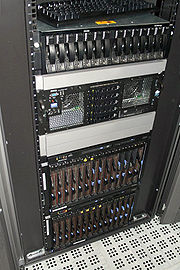
The My Opera Community server rack. From the top, user file storage (content of files.myopera.com), "bigma" (the master MySQL database server), and two IBM blade centers containing multi-purpose machines (Apache front ends, Apache back ends, slave MySQL database servers, load balancers, file servers, cache servers and sync masters).

Aside from the complex physical connections that make up its infrastructure, the Internet is facilitated by bi- or multi-lateral commercial contracts (e.g., peering agreements), and by technical specifications or protocols that describe how to exchange data over the network. Indeed, the Internet is defined by its interconnections and routing policies.

As of June 30, 2008, 1.463 billion people use the Internet according to Internet World Stats.[6]

Internet protocols

For more details on this topic, see Internet Protocol Suite.

The complex communications infrastructure of the Internet consists of its hardware components and a system of software layers that control various aspects of the architecture. While the hardware can often be used to support other software systems, it is the design and the rigorous standardization process of the software architecture that characterizes the Internet.

The responsibility for the architectural design of the Internet software systems has been delegated to the Internet Engineering Task Force (IETF).[7] The IETF conducts standard-setting work groups, open to any individual, about the various aspects of Internet architecture. Resulting discussions and final standards are published in Request for Comments (RFCs), freely available on the IETF web site.

The principal methods of networking that enable the Internet are contained in a series of RFCs that constitute the Internet Standards. These standards describe a system known as the Internet Protocol Suite. This is a model architecture that divides methods into a layered system of protocols (RFC 1122, RFC 1123). The layers correspond to the environment or scope in which their services operate. At the top is the space (Application Layer) of the software application, e.g., a web browser application, and just below it is the Transport Layer which connects applications on different hosts via the network (e.g., client-server model). The underlying network consists of two layers: the Internet Layer which enables computers to connect to one-another via intermediate (transit) networks and thus is the layer that establishes internetworking and the Internet, and lastly, at the bottom, is a software layer that provides connectivity between hosts on the same local link (therefor called Link Layer), e.g., a local area network (LAN) or a dial-up connection. This model is also known as the TCP/IP model of networking. While other models have been developed, such as the Open Systems Interconnection (OSI) model, they are not compatible in the details of description, nor implementation.

The most prominent component of the Internet model is the Internet Protocol (IP) which provides addressing systems for computers on the Internet and facilitates the internetworking of networks. IP Version 4 (IPv4) is the initial version used on the first generation of the today's Internet and is still in dominant use. It was designed to address up to ~4.3 billion (109) Internet hosts. However, the explosive growth of the Internet has led to IPv4 address exhaustion. A new protocol version, IPv6, was developed which provides vastly larger addressing capabilities and more efficient routing of data traffic. IPv6 is currently in commercial deployment phase around the world.

IPv6 is not interoperable with IPv4. It essentially establishes a "parallel" version of the Internet not accessible with IPv4 software. This means software upgrades are necessary for every networking device that needs to communicate on the IPv6 Internet. Most modern computer operating systems are already converted to operate with both versions of the Internet Protocol. Network infrastructures, however, are still lagging in this development.

Internet structure

There have been many analyses of the Internet and its structure. For example, it has been determined that the Internet IP routing structure and hypertext links of the World Wide Web are examples of scale-free networks.

Similar to the way the commercial Internet providers connect via Internet exchange points, research networks tend to interconnect into large subnetworks such as the following:

These in turn are built around relatively smaller networks. See also the list of academic computer network organizations.

In computer network diagrams, the Internet is often represented by a cloud symbol, into and out of which network communications can pass.

ICANN

ICANN headquarters in Marina Del Rey, California, United States
For more details on this topic, see ICANN.

The Internet Corporation for Assigned Names and Numbers (ICANN) is the authority that coordinates the assignment of unique identifiers on the Internet, including domain names, Internet Protocol (IP) addresses, and protocol port and parameter numbers. A globally unified namespace (i.e., a system of names in which there is at most one holder for each possible name) is essential for the Internet to function. ICANN is headquartered in Marina del Rey, California, but is overseen by an international board of directors drawn from across the Internet technical, business, academic, and non-commercial communities. The US government continues to have the primary role in approving changes to the root zone file that lies at the heart of the domain name system. Because the Internet is a distributed network comprising many voluntarily interconnected networks, the Internet has no governing body. ICANN's role in coordinating the assignment of unique identifiers distinguishes it as perhaps the only central coordinating body on the global Internet, but the scope of its authority extends only to the Internet's systems of domain names, IP addresses, protocol ports and parameter numbers.

On November 16, 2005, the World Summit on the Information Society, held in Tunis, established the Internet Governance Forum (IGF) to discuss Internet-related issues.

Language

For more details on this topic, see English on the Internet.
For more details on this topic, see Global Internet usage.
Further information: Unicode

The prevalent language for communication on the Internet is English. This may be a result of the Internet's origins, as well as English's role as a lingua franca. It may also be related to the poor capability of early computers, largely originating in the United States, to handle characters other than those in the English variant of the Latin alphabet.

After English (30% of Web visitors) the most requested languages on the World Wide Web are Chinese (17%), Spanish (9%), Japanese (7%), French (5%) and German (5%).[8]

By region, 40% of the world's Internet users are based in Asia, 26% in Europe, 17% in North America, 10% in Latin America and the Caribbean, 4% in Africa, 3% in the Middle East and 1% in Australia.[6]

The Internet's technologies have developed enough in recent years, especially in the use of Unicode, that good facilities are available for development and communication in most widely used languages. However, some glitches such as mojibake (incorrect display of foreign language characters, also known as kryakozyabry) still remain.

Internet and the workplace

The Internet is allowing greater flexibility in working hours and location, especially with the spread of unmetered high-speed connections and Web applications.

The Internet viewed on mobile devices

The Internet can now be accessed virtually anywhere by numerous means. Mobile phones, datacards, handheld game consoles and cellular routers allow users to connect to the Internet from anywhere there is a cellular network supporting that device's technology.

Within the limitations imposed by the small screen and other limited facilities of such a pocket-sized device, all the services of the Internet, including email and web browsing, may be available in this way. Service providers may restrict the range of these services and charges for data access may be significant, compared to home usage.

Common uses

E-mail

For more details on this topic, see E-mail.

The concept of sending electronic text messages between parties in a way analogous to mailing letters or memos predates the creation of the Internet. Even today it can be important to distinguish between Internet and internal e-mail systems. Internet e-mail may travel and be stored unencrypted on many other networks and machines out of both the sender's and the recipient's control. During this time it is quite possible for the content to be read and even tampered with by third parties, if anyone considers it important enough. Purely internal or intranet mail systems, where the information never leaves the corporate or organization's network, are much more secure, although in any organization there will be IT and other personnel whose job may involve monitoring, and occasionally accessing, the e-mail of other employees not addressed to them.

The World Wide Web

For more details on this topic, see World Wide Web.
Graphic representation of a minute fraction of the WWW, demonstrating hyperlinks

Many people use the terms Internet and World Wide Web (or just the Web) interchangeably, but, as discussed above, the two terms are not synonymous.

The World Wide Web is a huge set of interlinked documents, images and other resources, linked by hyperlinks and URLs. These hyperlinks and URLs allow the web servers and other machines that store originals, and cached copies, of these resources to deliver them as required using HTTP (Hypertext Transfer Protocol). HTTP is only one of the communication protocols used on the Internet.

Web services also use HTTP to allow software systems to communicate in order to share and exchange business logic and data.

Software products that can access the resources of the Web are correctly termed user agents. In normal use, web browsers, such as Internet Explorer, Firefox and Apple Safari, access web pages and allow users to navigate from one to another via hyperlinks. Web documents may contain almost any combination of computer data including graphics, sounds, text, video, multimedia and interactive content including games, office applications and scientific demonstrations.

Through keyword-driven Internet research using search engines like Yahoo! and Google, millions of people worldwide have easy, instant access to a vast and diverse amount of online information. Compared to encyclopedias and traditional libraries, the World Wide Web has enabled a sudden and extreme decentralization of information and data.

Using the Web, it is also easier than ever before for individuals and organisations to publish ideas and information to an extremely large audience. Anyone can find ways to publish a web page, a blog or build a website for very little initial cost. Publishing and maintaining large, professional websites full of attractive, diverse and up-to-date information is still a difficult and expensive proposition, however.

Many individuals and some companies and groups use "web logs" or blogs, which are largely used as easily updatable online diaries. Some commercial organisations encourage staff to fill them with advice on their areas of specialization in the hope that visitors will be impressed by the expert knowledge and free information, and be attracted to the corporation as a result. One example of this practice is Microsoft, whose product developers publish their personal blogs in order to pique the public's interest in their work.

Collections of personal web pages published by large service providers remain popular, and have become increasingly sophisticated. Whereas operations such as Angelfire and GeoCities have existed since the early days of the Web, newer offerings from, for example, Facebook and MySpace currently have large followings. These operations often brand themselves as social network services rather than simply as web page hosts.

Advertising on popular web pages can be lucrative, and e-commerce or the sale of products and services directly via the Web continues to grow.

In the early days, web pages were usually created as sets of complete and isolated HTML text files stored on a web server. More recently, websites are more often created using content management system (CMS) or wiki software with, initially, very little content. Contributors to these systems, who may be paid staff, members of a club or other organisation or members of the public, fill underlying databases with content using editing pages designed for that purpose, while casual visitors view and read this content in its final HTML form. There may or may not be editorial, approval and security systems built into the process of taking newly entered content and making it available to the target visitors.

Remote access

Further information: Remote access

The Internet allows computer users to connect to other computers and information stores easily, wherever they may be across the world. They may do this with or without the use of security, authentication and encryption technologies, depending on the requirements.

This is encouraging new ways of working from home, collaboration and information sharing in many industries. An accountant sitting at home can audit the books of a company based in another country, on a server situated in a third country that is remotely maintained by IT specialists in a fourth. These accounts could have been created by home-working bookkeepers, in other remote locations, based on information e-mailed to them from offices all over the world. Some of these things were possible before the widespread use of the Internet, but the cost of private leased lines would have made many of them infeasible in practice.

An office worker away from his desk, perhaps on the other side of the world on a business trip or a holiday, can open a remote desktop session into his normal office PC using a secure Virtual Private Network (VPN) connection via the Internet. This gives the worker complete access to all of his or her normal files and data, including e-mail and other applications, while away from the office.

This concept is also referred to by some network security people as the Virtual Private Nightmare, because it extends the secure perimeter of a corporate network into its employees' homes; this has been the source of some notable security breaches, but also provides security for the workers.

Collaboration

See also: Collaborative software

The low cost and nearly instantaneous sharing of ideas, knowledge, and skills has made collaborative work dramatically easier. Not only can a group cheaply communicate and test, but the wide reach of the Internet allows such groups to easily form in the first place, even among niche interests. An example of this is the free software movement in software development, which produced GNU and Linux from scratch and has taken over development of Mozilla and OpenOffice.org (formerly known as Netscape Communicator and StarOffice).

Internet "chat", whether in the form of IRC "chat rooms" or channels, or via instant messaging systems, allow colleagues to stay in touch in a very convenient way when working at their computers during the day. Messages can be sent and viewed even more quickly and conveniently than via e-mail. Extension to these systems may allow files to be exchanged, "whiteboard" drawings to be shared as well as voice and video contact between team members.

Version control systems allow collaborating teams to work on shared sets of documents without either accidentally overwriting each other's work or having members wait until they get "sent" documents to be able to add their thoughts and changes.

File sharing

For more details on this topic, see File sharing.

A computer file can be e-mailed to customers, colleagues and friends as an attachment. It can be uploaded to a website or FTP server for easy download by others. It can be put into a "shared location" or onto a file server for instant use by colleagues. The load of bulk downloads to many users can be eased by the use of "mirror" servers or peer-to-peer networks.

In any of these cases, access to the file may be controlled by user authentication; the transit of the file over the Internet may be obscured by encryption, and money may change hands before or after access to the file is given. The price can be paid by the remote charging of funds from, for example, a credit card whose details are also passed—hopefully fully encrypted—across the Internet. The origin and authenticity of the file received may be checked by digital signatures or by MD5 or other message digests.

These simple features of the Internet, over a worldwide basis, are changing the basis for the production, sale, and distribution of anything that can be reduced to a computer file for transmission. This includes all manner of print publications, software products, news, music, film, video, photography, graphics and the other arts. This in turn has caused seismic shifts in each of the existing industries that previously controlled the production and distribution of these products.

Internet collaboration technology enables business and project teams to share documents, calendars and other information. Such collaboration occurs in a wide variety of areas including scientific research, software development, conference planning, political activism and creative writing.

Streaming media

Many existing radio and television broadcasters provide Internet "feeds" of their live audio and video streams (for example, the BBC). They may also allow time-shift viewing or listening such as Preview, Classic Clips and Listen Again features. These providers have been joined by a range of pure Internet "broadcasters" who never had on-air licenses. This means that an Internet-connected device, such as a computer or something more specific, can be used to access on-line media in much the same way as was previously possible only with a television or radio receiver. The range of material is much wider, from pornography to highly specialized, technical webcasts. Podcasting is a variation on this theme, where—usually audio—material is first downloaded in full and then may be played back on a computer or shifted to a digital audio player to be listened to on the move. These techniques using simple equipment allow anybody, with little censorship or licensing control, to broadcast audio-visual material on a worldwide basis.

Webcams can be seen as an even lower-budget extension of this phenomenon. While some webcams can give full-frame-rate video, the picture is usually either small or updates slowly. Internet users can watch animals around an African waterhole, ships in the Panama Canal, the traffic at a local roundabout or their own premises, live and in real time. Video chat rooms, video conferencing, and remote controllable webcams are also popular. Many uses can be found for personal webcams in and around the home, with and without two-way sound.

YouTube, sometimes described as an Internet phenomenon because of the vast amount of users and how rapidly the site's popularity has grown, was founded on February 15, 2005. It is now the leading website for free streaming video. It uses a flash-based web player which streams video files in the format FLV. Users are able to watch videos without signing up; however, if users do sign up they are able to upload an unlimited amount of videos and they are given their own personal profile. It is currently estimated that there are 64,000,000 videos on YouTube, and it is also currently estimated that 825,000 new videos are uploaded every day.

Voice telephony (VoIP)

For more details on this topic, see VoIP.

VoIP stands for Voice over IP, where IP refers to the Internet Protocol that underlies all Internet communication. This phenomenon began as an optional two-way voice extension to some of the instant messaging systems that took off around the year 2000. In recent years many VoIP systems have become as easy to use and as convenient as a normal telephone. The benefit is that, as the Internet carries the actual voice traffic, VoIP can be free or cost much less than a normal telephone call, especially over long distances and especially for those with always-on Internet connections such as cable or ADSL.

Thus, VoIP is maturing into a viable alternative to traditional telephones. Interoperability between different providers has improved and the ability to call or receive a call from a traditional telephone is available. Simple, inexpensive VoIP modems are now available that eliminate the need for a PC.

Voice quality can still vary from call to call but is often equal to and can even exceed that of traditional calls.

Remaining problems for VoIP include emergency telephone number dialing and reliability. Currently, a few VoIP providers provide an emergency service, but it is not universally available. Traditional phones are line-powered and operate during a power failure; VoIP does not do so without a backup power source for the electronics.

Most VoIP providers offer unlimited national calling, but the direction in VoIP is clearly toward global coverage with unlimited minutes for a low monthly fee.

VoIP has also become increasingly popular within the gaming world, as a form of communication between players. Popular gaming VoIP clients include Ventrilo and Teamspeak, and there are others available also. The PlayStation 3 and Xbox 360 also offer VoIP chat features.

saadadadadasdasdasdasdas